
Tax

Real estate investor reviewing passive activity loss rules on tax return

Passive Activity Loss Rules for Real Estate Investors: What You Can and Can’t Deduct

You bought a rental property. You ran the numbers. Between depreciation, mortgage interest, and operating expenses, the property generates a $30,000 tax loss on paper even though it’s cash-flow positive. You expected that loss to reduce your W-2 income and save you $10,000 in taxes. Then your CPA tells you the loss is “suspended.” You

Passive Activity Loss Rules for Real Estate Investors: What You Can and Can’t Deduct Read More »

Investor reviewing Schedule K-1 from real estate fund with CPA

What Your K-1 From a Real Estate Fund Actually Means (A Plain-English Guide)

If you’ve invested in a real estate fund or syndication and just received your first Schedule K-1, you’re probably staring at a multi-page document filled with box numbers, codes, and dollar amounts that don’t seem to connect to any number you recognize. You know how much you invested. You know how much cash you received.

What Your K-1 From a Real Estate Fund Actually Means (A Plain-English Guide) Read More »

Calendar showing K-1 deadline with penalty calculation for real estate fund

What Happens If Your Fund’s K-1s Are Late? Penalties, Extensions, and How to Avoid It

Late K-1s are one of the most common operational failures in real estate funds. And unlike most operational problems, this one hits you from two directions at once: IRS penalties that cost real money and LP frustration that costs future capital. We deal with K-1 timing issues every tax season. Sometimes the delay is the

What Happens If Your Fund’s K-1s Are Late? Penalties, Extensions, and How to Avoid It Read More »

Form 1065 real estate partnership tax return with Schedule K-1

Form 1065 for Real Estate Partnerships: What Fund Managers Need to Know

If you run a real estate partnership or fund, Form 1065 is the most important tax document your fund produces each year. It’s the federal partnership return that reports the fund’s income, deductions, gains, losses, and credits to the IRS. And it generates the Schedule K-1s that every investor needs to file their personal return.

Form 1065 for Real Estate Partnerships: What Fund Managers Need to Know Read More »

Real estate investor tax deductions checklist with calculator and property documents

The Complete Tax Deduction Checklist for Real Estate Investors (2026)

Every year we review tax returns for new clients and find deductions they missed. Not obscure ones. Basic, well-established deductions that their prior CPA either didn’t know about or didn’t ask about. The tax code gives real estate investors more deductions than almost any other type of investment. But you only get the benefit if

The Complete Tax Deduction Checklist for Real Estate Investors (2026) Read More »

Real estate investor tracking hours for real estate professional status qualification

Real Estate Professional Status: How to Qualify and Why It Matters for Your Taxes

Real estate professional status (REPS) is the most powerful tax classification available to real estate investors. If you qualify, you can deduct rental losses against your W-2 income, business income, and virtually any other income you have. No passive activity limits. No $25,000 cap. It’s also the most misunderstood and most aggressively audited tax strategy

Real Estate Professional Status: How to Qualify and Why It Matters for Your Taxes Read More »

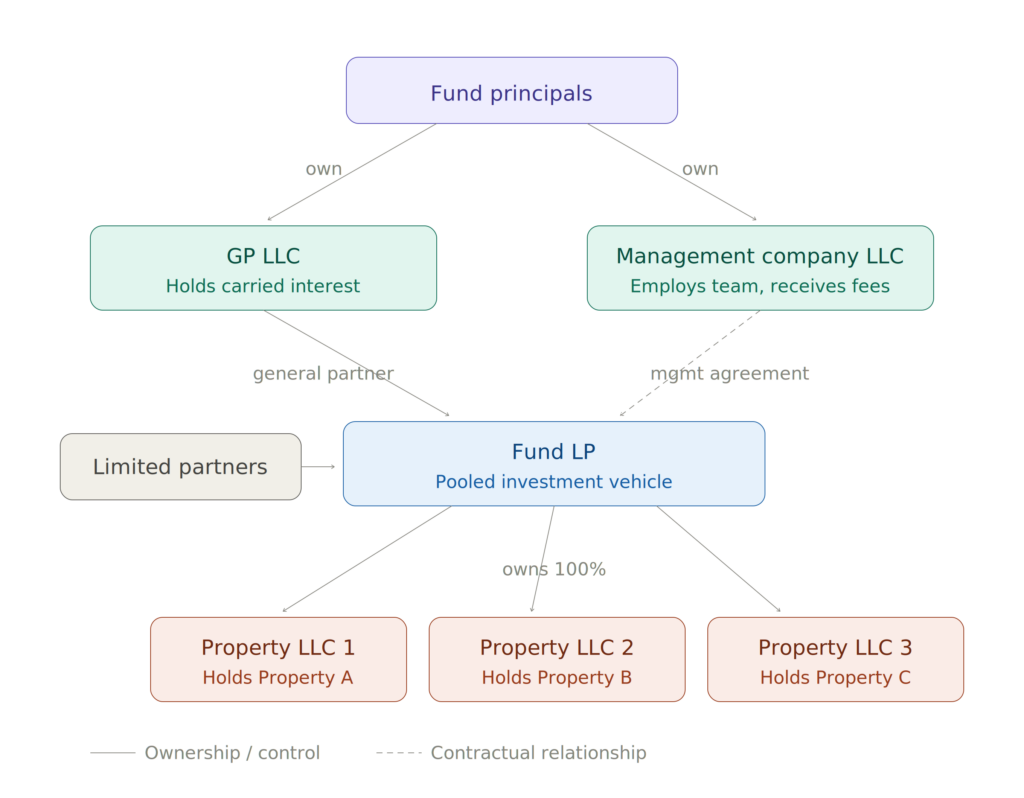
Real estate fund entity structure diagram showing GP LLC management company and property LLCs

Best Entity Structure for a Real Estate Fund: LP, LLC, or Something Else?

When GPs ask us, “What’s the best entity structure for a real estate fund?” they usually mean the fund entity itself. Should it be an LLC or a limited partnership? That’s the wrong question. Or at least, it’s an incomplete one. Your fund isn’t one entity. It’s a stack of entities, and each one serves

Best Entity Structure for a Real Estate Fund: LP, LLC, or Something Else? Read More »

Cost segregation study results for real estate fund property

Cost Segregation for Real Estate Funds: When It Makes Sense and How It Works

Cost segregation is one of those strategies that every real estate fund manager has heard about, but few fully understand at the fund level. Most of the content online explains it for individual investors. Buy a rental property, run a cost seg study, take a big first-year deduction. At the fund level, it’s more nuanced.

Cost Segregation for Real Estate Funds: When It Makes Sense and How It Works Read More »