
Real Estate

Real estate fund accounting setup checklist on desk with laptop

How to Set Up Accounting for Your Real Estate Fund From Day One

You’ve hired the attorney. The PPM is drafted. The LPA is signed. You’re about to start raising capital. Now someone asks: “Who’s handling the accounting?” If the answer is “we’ll figure it out after the first close,” you’re already behind. The accounting setup needs to happen before your first capital call, not after. Every dollar

How to Set Up Accounting for Your Real Estate Fund From Day One Read More »

Real estate investor tracking hours for real estate professional status qualification

Real Estate Professional Status: How to Qualify and Why It Matters for Your Taxes

Real estate professional status (REPS) is the most powerful tax classification available to real estate investors. If you qualify, you can deduct rental losses against your W-2 income, business income, and virtually any other income you have. No passive activity limits. No $25,000 cap. It’s also the most misunderstood and most aggressively audited tax strategy

Real Estate Professional Status: How to Qualify and Why It Matters for Your Taxes Read More »

Real estate fund manager comparing accounting software options on laptop

Best Accounting Software for Real Estate Funds in 2026

Every fund manager asks us this question: “What’s the best accounting software for my fund?” The honest answer? There’s no single platform that does everything a real estate fund needs. And the question itself is usually the wrong question, because most GPs are actually asking about two completely different problems without realizing it. Problem one:

Best Accounting Software for Real Estate Funds in 2026 Read More »

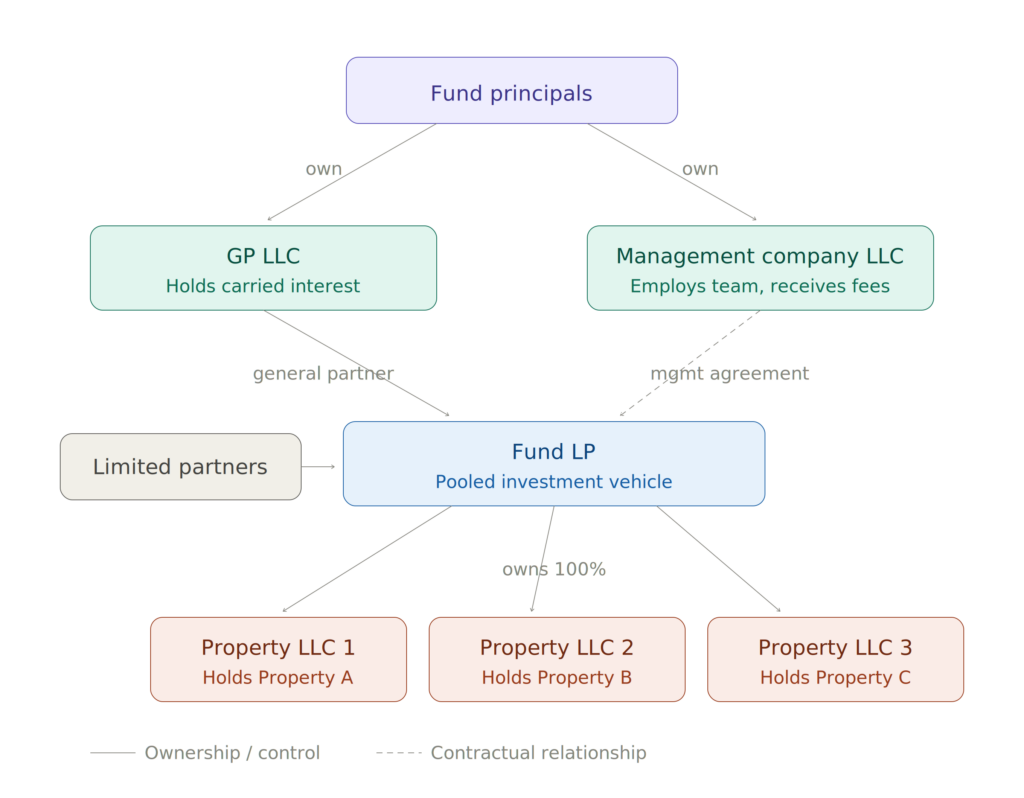
Real estate fund entity structure diagram showing GP LLC management company and property LLCs

Best Entity Structure for a Real Estate Fund: LP, LLC, or Something Else?

When GPs ask us, “What’s the best entity structure for a real estate fund?” they usually mean the fund entity itself. Should it be an LLC or a limited partnership? That’s the wrong question. Or at least, it’s an incomplete one. Your fund isn’t one entity. It’s a stack of entities, and each one serves

Best Entity Structure for a Real Estate Fund: LP, LLC, or Something Else? Read More »

Cost segregation study results for real estate fund property

Cost Segregation for Real Estate Funds: When It Makes Sense and How It Works

Cost segregation is one of those strategies that every real estate fund manager has heard about, but few fully understand at the fund level. Most of the content online explains it for individual investors. Buy a rental property, run a cost seg study, take a big first-year deduction. At the fund level, it’s more nuanced.

Cost Segregation for Real Estate Funds: When It Makes Sense and How It Works Read More »

Real estate fund accounting financial statements and capital account reports

Real Estate Fund Accounting: A Complete Guide for Fund Managers

Real estate fund accounting is not the same as property-level bookkeeping. If you’ve been managing individual rentals or syndications and you’re stepping into a fund structure, the accounting requirements change significantly. It’s not just “more” accounting. It’s a fundamentally different discipline. You’re tracking capital across multiple entities, allocating income through a waterfall, maintaining individual investor

Real Estate Fund Accounting: A Complete Guide for Fund Managers Read More »

Real estate fund manager reviewing bonus depreciation strategy 2026

Bonus Depreciation for Real Estate in 2026: What Changed and What It Means for Your Fund

If you manage a real estate fund, you already know that depreciation is one of the most powerful tax tools available to your investors. What you might not fully appreciate is how dramatically the rules just changed, and what that means for how you acquire, hold, and communicate the tax benefits of your fund. The

Bonus Depreciation for Real Estate in 2026: What Changed and What It Means for Your Fund Read More »